Financial software where accuracy and audit trails come first
Nexlantic builds payment, lending, banking and reporting systems for fintech companies and financial teams, engineered for correctness under load and for the scrutiny of auditors and regulators.
Designed around
- PCI DSS
- SOC 2
- KYC and AML requirements
- GDPR and CCPA
- PSD2 and open banking APIs
Software built for the realities of finance
Money software has no tolerance for rounding errors, duplicate transactions or reports that disagree with the ledger. We build financial systems on explicit data models, idempotent payment flows and double-entry principles, with every balance change traceable to the event that caused it. Reconciliation is designed in from the start, so finance teams can close the books without exporting to spreadsheets to find the difference.
Regulation shapes the architecture. Card data stays inside a tokenized, PCI DSS scoped boundary; customer identity passes through KYC and sanctions checks before an account is opened; every administrative action is logged for SOC 2 and internal audit. We integrate with payment processors, banking APIs, open banking providers and market data feeds, and we keep the integration layer isolated so a vendor change does not become a rewrite.
What makes building for finance hard
The constraints we plan for before the first line of code.
Correctness under concurrency
Thousands of simultaneous transactions must never double-charge, double-credit or leave a balance that the ledger cannot explain.
Compliance scope creep
PCI DSS, KYC/AML, SOC 2 and data residency rules each add controls; without careful boundaries the whole system ends up in scope.
Legacy cores and vendor APIs
Core banking systems, processors and data vendors have their own formats, rate limits and outages that the product must absorb gracefully.
Fraud and account takeover
Payment and account flows are targeted constantly; step-up authentication, velocity checks and anomaly detection have to be built in.
What we design and deliver for finance
Payment and wallet platforms
Card, bank transfer and wallet flows with tokenization, idempotent processing, refunds, disputes and settlement reporting.
Lending and onboarding systems
Digital applications, KYC and document checks, decisioning rules, e-signature and servicing dashboards.
Banking and customer portals
Account views, statements, transfers, cards and support on web and mobile with strong authentication.
Trading and analytics dashboards
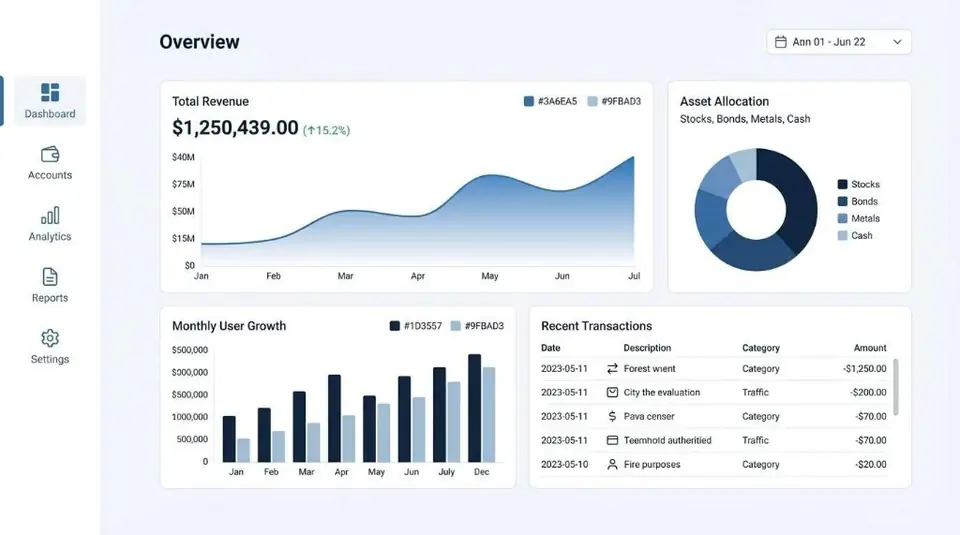
Real-time positions, risk metrics and performance reporting over high-volume transaction and market data.
Regulatory and management reporting
Automated reconciliation, audit trails and Power BI reporting for finance, compliance and leadership.
Fraud and risk tooling
Rule engines, velocity checks and machine-learning scoring with case management for analysts.
Our finance work
Services we bring to finance
Web Development
Custom web applications built with React, Next.js, and modern frameworks. Scalable, secure, and optimized for performance.
Learn moreCloud Solutions
Cloud architecture, migration, and DevOps on AWS, Azure, and GCP. Infrastructure that scales with your business.
Learn moreData Analytics
Turn enterprise data into insight with modern analytics pipelines, visualization, and decision intelligence.
Learn moreAI Solutions
Machine learning models, natural language processing, computer vision, and intelligent automation for your products.
Learn more
Finance questions, answered
Answers to what prospective clients in this sector ask first.
By never storing it. Card entry uses hosted fields or SDKs from the payment processor, which return a token your platform stores instead. That keeps your servers, databases and logs outside most of the PCI DSS scope, and we design the network and access controls around that boundary from the first sprint.
Yes. We build integrations with payment processors, banking and open banking APIs, KYC providers and market data feeds. Each lives behind an adapter with retries, idempotency keys and monitoring, so a vendor outage or API change is contained in one place rather than spread through the product.
With the finance team's own examples. Interest, fees, FX and settlement logic get unit tests built from worked cases your analysts sign off, run on every commit. Money is handled in integer minor units or decimal types, never floating point, and end-to-end tests replay realistic transaction streams and compare the resulting ledger to expected balances.
We build the technical controls auditors look for: role-based access with least privilege, centralized logging, change management through code review and CI/CD, encrypted data, backups with tested restores and documented incident procedures. SOC 2 attestation covers your organization as a whole, so we supply evidence for the systems we build and work alongside your auditor.
Building for finance?
Tell us about your product, your compliance obligations and your timeline. We will map a delivery plan with you.