Learning platforms students and teachers actually use
Nexlantic builds learning management systems, virtual classrooms and student portals for schools, universities and training providers, with the accessibility and data protection that education demands.
Designed around
- FERPA
- COPPA
- WCAG 2.2 and Section 508
- LTI 1.3
- SCORM and xAPI
Software built for the realities of education
Education software is judged in the classroom, not the demo. A course page that loads slowly on a shared laptop, a quiz that fails on a phone, or a gradebook that confuses a teacher gets abandoned within a term. We build learning platforms around the daily routines of students, instructors and administrators, and test them on the low-end devices and patchy networks that real campuses run on.
Institutions rarely start from nothing. A student information system, a payment gateway, a video provider and an identity directory are usually already in place. Our work connects those pieces using standards such as LTI 1.3, SCORM and xAPI, single sign-on through SAML or OIDC, and clean APIs, so content, enrollments and grades flow without manual re-entry and student records stay protected under FERPA and COPPA.
What makes building for education hard
The constraints we plan for before the first line of code.
Engagement drops off fast
Courses that are hard to navigate or slow on mobile lose learners within weeks; completion depends on the experience, not just the content.
Many systems, one student
SIS, LMS, video, payments and identity tools each hold part of the picture, and reconciling them by hand drains administrative staff.
Accessibility is a legal duty
Public institutions must meet WCAG and Section 508; captions, keyboard navigation and screen-reader support cannot be left for later.
Student data is sensitive
FERPA, COPPA and GDPR govern who can see grades, attendance and behavior records, including third-party tools plugged into the platform.
What we design and deliver for education
Learning management systems
Course authoring, enrollments, assignments, grading and discussion built to your institution's teaching model.
Virtual classrooms
Live lessons with video, breakout rooms, whiteboards, attendance and recordings that stay attached to the course.
Student and parent portals
Timetables, fees, results, messaging and notifications on web and mobile, with role-based views for guardians.
Assessment and proctoring tools
Question banks, adaptive quizzes, plagiarism checks and secure exam delivery with detailed item analysis.
Learning analytics
Dashboards on progress, engagement and risk indicators so advisors can intervene before a student falls behind.
Admissions and administration
Application workflows, document verification, scheduling and reporting for registrars and admissions offices.
Our education work
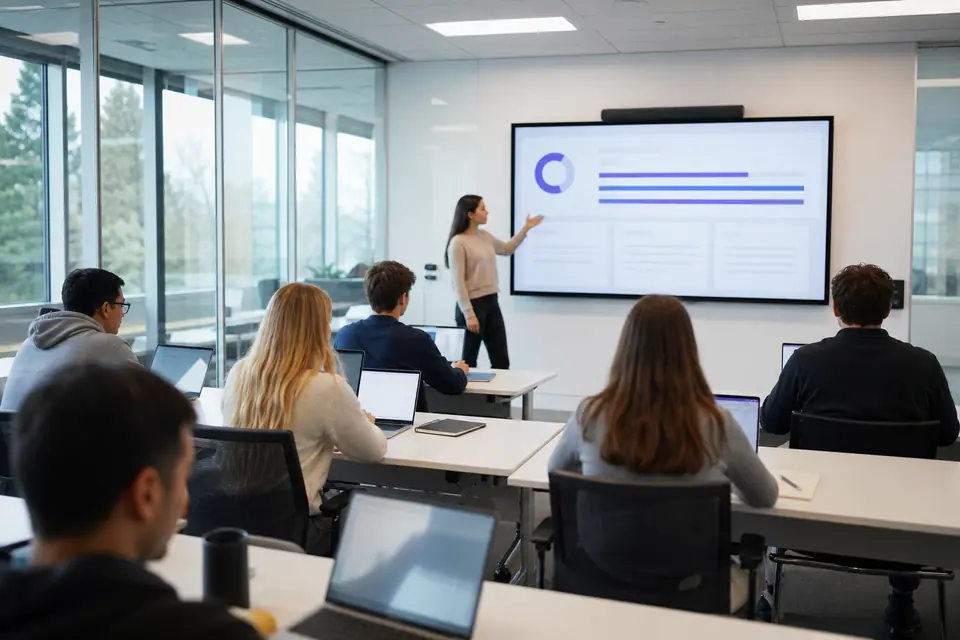
Services we bring to education
Web Development
Custom web applications built with React, Next.js, and modern frameworks. Scalable, secure, and optimized for performance.
Learn moreMobile Apps
Native iOS and Android apps plus cross-platform solutions with React Native and Flutter for maximum reach.
Learn moreUI/UX Design
Research-driven design systems, wireframes, prototypes, and polished interfaces that users love.
Learn moreData Analytics
Turn enterprise data into insight with modern analytics pipelines, visualization, and decision intelligence.
Learn more
Education questions, answered
Answers to what prospective clients in this sector ask first.
Configure an existing platform when your teaching model fits its assumptions. Build when it does not: unusual course structures, tight integration with your own systems, white-label delivery for partners, or pricing that no longer works at your scale. We will say which applies after a short discovery, and we build on open standards either way.
Yes. We connect learning platforms to student information systems, identity providers and payment gateways through their APIs, LTI 1.3, OneRoster or scheduled data exchanges. Enrollments, rosters and grades then move automatically, and single sign-on means students and staff keep one set of credentials.
Accessibility is part of the definition of done. Interfaces are built to WCAG 2.2 AA: semantic markup, full keyboard operation, visible focus, sufficient contrast, captions for video and screen-reader testing on each release. For public institutions we document conformance to support Section 508 and procurement reviews.
We design for it. Pages are kept light, content is cached for offline reading where the platform allows, video is served at adaptive bitrates, and quizzes save progress continuously so a dropped connection does not lose work. Mobile apps built with React Native or Flutter can sync when a connection returns.
Building for education?
Tell us about your product, your compliance obligations and your timeline. We will map a delivery plan with you.