One system of record for finance, stock and operations
Nexlantic builds ERP platforms where orders, stock, purchasing, payroll and the general ledger share one database, so reports agree and staff stop re-keying data between tools.
- .NET
- React
- PostgreSQL
- Azure
How we approach erp and operations platforms
An ERP platform is the operational backbone of a company: every sale, purchase, stock movement and payment passes through it, and finance closes the books from what it records. The hardest part is not any single module but keeping them consistent. We design the data model before the screens, decide which process owns each record, and build modules on that foundation so a goods receipt updates stock, the supplier ledger and the cost of sales in one transaction.
Our builds use .NET services with a React front end, PostgreSQL for transactional data with append-only audit tables, and Azure for hosting with private networking and managed backups. Integrations with banks, e-commerce, carriers, payroll providers and any ERP you keep for part of the business run as monitored services. Modules roll out one process at a time, with the old spreadsheet or system running alongside until reconciliation reports match.
Modules this kind of system usually needs
General ledger and finance
Chart of accounts, journals, payables, receivables, bank reconciliation, multi-currency and period close with full audit trails.
Inventory and warehouse
Stock by location, lot and serial, barcode receiving and picking, transfers, reorder points and cycle counts.
Purchasing and approvals
Requisitions, approval chains, purchase orders, goods receipt and three-way matching against supplier invoices.
Sales orders and invoicing
Quotes, orders, fulfilment status, invoicing with pricing rules and credit limits, and exports to tax and e-invoicing services.
HR, time and payroll
Employee records, leave, attendance and payroll inputs with role-based access and exports to your payroll provider.
Reporting and dashboards
Operational and financial reporting in Power BI or in-app, built on the same tables that run the business.
How it is typically built
The structural decisions that keep the platform secure, observable and ready to grow.
- .NET services organized by business domain, with each posting written as a single database transaction across stock, ledger and costing
- React front end with role-based screens, keyboard-first data entry and barcode input for warehouse and receiving
- PostgreSQL with row-level security per legal entity, append-only audit tables and point-in-time recovery
- Azure hosting with private endpoints, managed identity, Key Vault and automated backups, defined with infrastructure as code
- Integration services for banks, e-commerce, carriers and payroll providers with retries, idempotent writes and alerting
- Staged migration tooling that loads master data, then open transactions and balances, with reconciliation reports per batch
What goes into this build
Web Development
Custom web applications built with React, Next.js, and modern frameworks. Scalable, secure, and optimized for performance.
Learn moreCloud Solutions
Cloud architecture, migration, and DevOps on AWS, Azure, and GCP. Infrastructure that scales with your business.
Learn moreData Analytics
Turn enterprise data into insight with modern analytics pipelines, visualization, and decision intelligence.
Learn moreMaintenance & Support
Proactive monitoring, bug fixes, security updates, and continuous improvement to keep your software running flawlessly.
Learn more
Related work

CRM and customer platforms
Pipelines, account management, customer portals and support desks with automation and reporting built in.
- Next.js
- Node.js
- PostgreSQL
- AWS
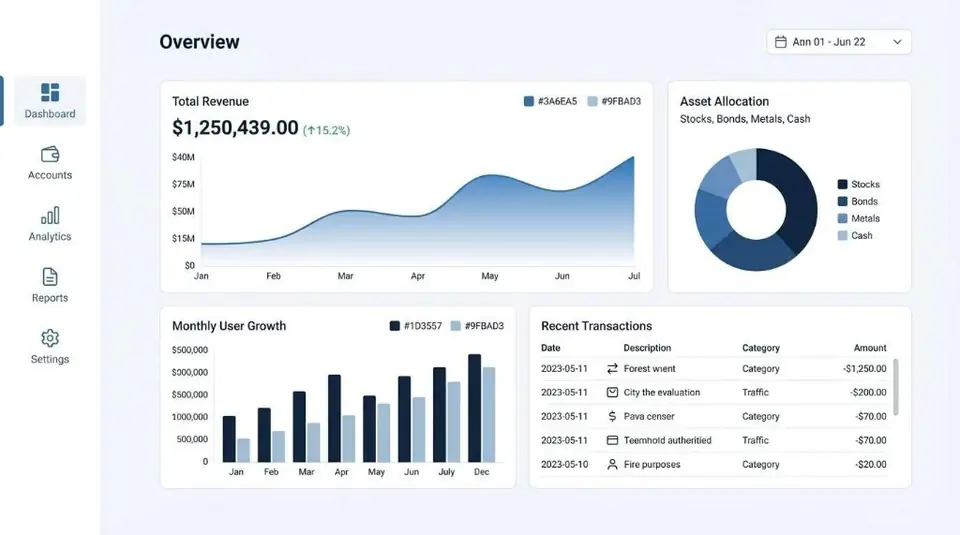
Financial analytics dashboards
Real-time reporting over high-volume transaction data, built for auditability and uptime.
- Next.js
- Python
- MongoDB
- Azure
ERP and operations platforms: common questions
No, and we advise against it. Most companies start with the process that hurts most, often inventory or purchasing, run it alongside the existing tool until the numbers reconcile, then move finance and the remaining modules in planned stages. Each stage has its own acceptance criteria and rollback plan.
Yes. Many clients keep a packaged ERP for the general ledger and use the custom platform for operations that the package handles poorly. We agree which system owns each record, post summarized or detailed journals across through the ERP's API, and reconcile both sides automatically.
Every posting is written in one database transaction so stock, ledger and costing cannot drift apart, records are never deleted but reversed, and audit tables capture who changed what and when. Period close locks prior periods, and reports are built from the same tables that run operations rather than a separate copy.
Have a similar system in mind?
Share your requirements and we will outline an architecture, a team and a timeline.